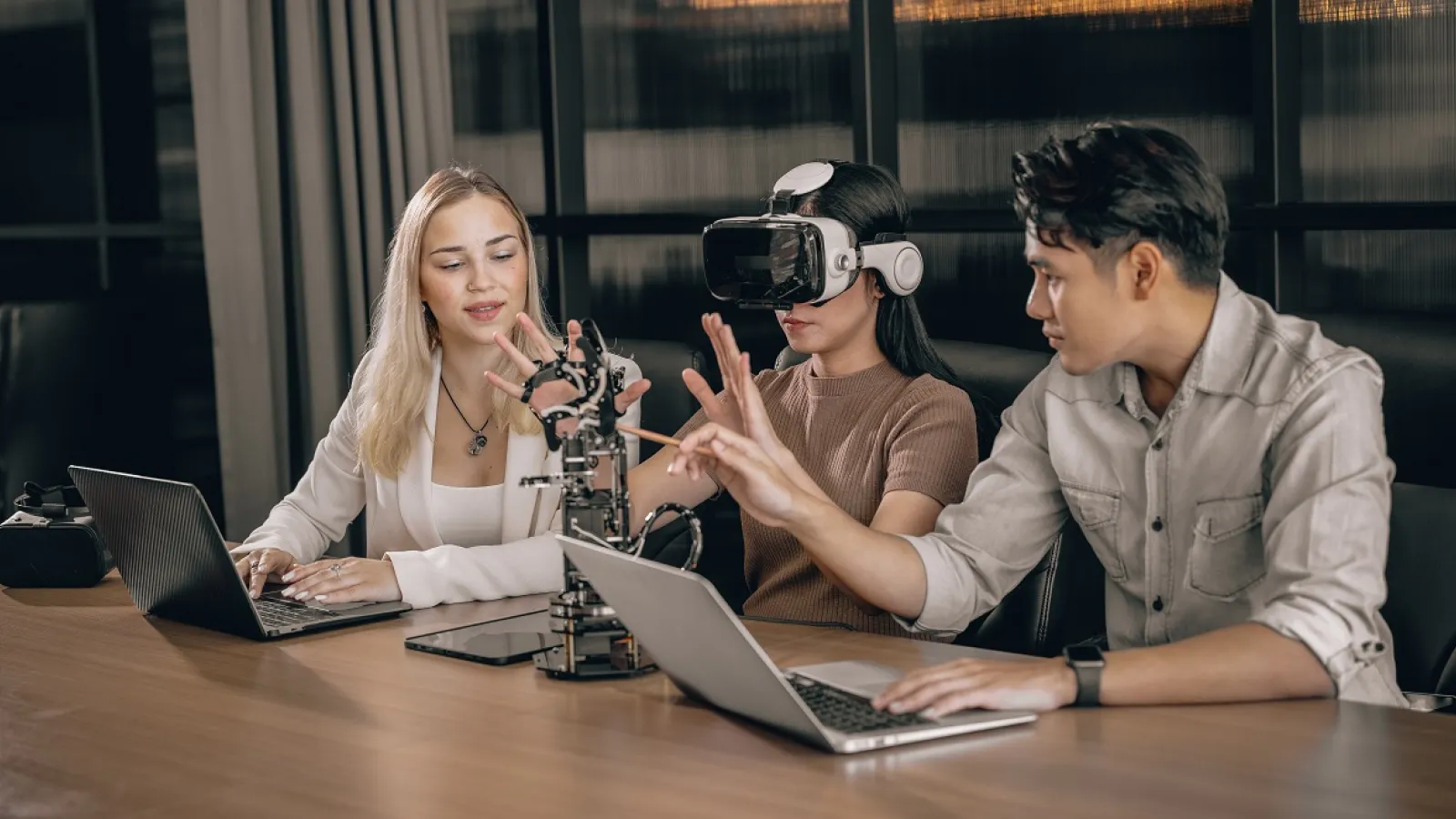
What is Immersive Learning?
Immersive learning refers to pedagogical approaches that use technologies such as virtual reality (VR), augmented reality (AR), mixed reality (MR), and interactive digital environments to create learning experiences that engage learners deeply through presence, realism and embodied interaction. Across higher education, immersive learning has become an innovative way to improve engagement, competence development, and experiential learning opportunities that traditional classrooms may not fully support.
A wide range of technologies has been used to implement immersive learning:
- Virtual Reality (VR) through head-mounted displays (HMDS), simulations, and virtual worlds (Radianti et al., 2020; de Freitas et al., 2010);
- Augmented Reality (AR) overlays and mobile-based experiences (Prit Kaur et al., 2022);
- Mixed Reality (MR) environments integrating physical and digital objects (Kuhail et al., 2022);
- Interactive platforms and digital storytelling systems (Jantakoon et al., 2019).
These technologies enable learners to perform tasks, role-play, solve problems, and practice competencies in safe, controlled and customized environments. Immersive learning can be integrated at the course level, but it is increasingly understood as an institutional innovation, requiring strategic planning, digital accessibility and instructor training (Artyukhov et al., 2023; Cabrera-Duffaut et al., 2024).
Perspectives from Review Studies: How Scholars Understand Immersive Learning
The following four review studies collectively portray immersive learning as a developing field.
Radianti et al. (2020) characterize immersive learning primarily through VR-based applications in higher education, emphasizing that while technological innovation is strong, pedagogical foundations are not consistently articulated. They argue that VR implementations often lack clear theoretical grounding and robust assessment of learning, focusing instead on usability or engagement. Cabrera-Duffaut et al. (2024) focus on competence development, finding that VR supports skills such as collaboration, communication, and problem-solving. They conclude that immersive learning holds strong promise for preparing students for workplace demands but requires institutional investment in training, software development, and curricular integration.
Kuhail et al. (2022) found that immersive learning experiences are deeply shaped by interaction design, domain specificity, and learning goals. Their analysis across 42 immersive learning experiences revealed that immersive learning is still heavily STEM-oriented and that the technical affordances of VR, AR, and MR are often underutilized pedagogically. They advocate for designers to think about immersive technologies less as content-delivery systems and more as interactive spaces influenced by learner agency, presence, and collaboration. Similarly, from an engineering education perspective, Prit Kaur et al. (2022) argue that interactive and immersive technologies are particularly valuable for helping students visualize complex systems, conceptualize abstract ideas, and sustain motivation. Their review highlights the learner-centered potential of AR/VR but points out persistent infrastructure barriers, including hardware cost, limited classroom readiness, and uneven instructor expertise.
Across these reviews, immersive learning is therefore framed as technologically advanced and promising, but unevenly implemented and pedagogically inconsistent.
Conceptual Perspectives: Models that Explain How Immersive Learning Works
There are several examples of theoretical scaffolds that help explain how immersive learning works and how it should be designed.
CAMIL: A Cognitive-Affective Model for Immersive Learning
Makransky and Petersen (2021) propose the Cognitive Affective Model of Immersive Learning (CAMIL), which synthesizes psychological research to explain how VR-based learning environments influence cognitive and affective systems. The model highlights:
- Presence and agency as psychological affordances of immersive media;
- Motivation, interest, self-efficacy, cognitive load, and self-regulation as mediating factors;
- Factual, conceptual, procedural, and transfer learning as outcomes.
CAMIL reframes VR not merely as a delivery tool but as a medium that can fundamentally alter learners’ motivational and cognitive engagement. Importantly, Makransky and Petersen (2021) argue that many VR studies overlook cognitive load and representational fidelity, which are crucial to effective immersive instruction.
EFiL: A Framework Balancing Immersion with Learner Readiness
Dengel and Mägdefrau (2018) extend this discussion by proposing the Educational Framework for Immersive Learning (EFiL). This framework distinguishes between:
- Objective immersion from the technology (vividness, interactivity), and
- Subjective learning potential (motivation, emotion, cognition).
They position immersive learning as the mediator between technology and learning outcomes. Their contribution emphasizes that immersive learning success depends as much on learners’ capacities and readiness as on the sophistication of the technology itself.
The Immersive University Model
At an institutional level, Artyukhov et al. (2023) conceptualize immersive learning as part of a broader “electronic university” vision. By combining bibliometric analysis with a multi-dimensional immersive learning model, they argue that immersive environments should be embedded into university ecosystems, from curricular planning to assessment frameworks. Unlike the previous conceptual models focusing on psychological processes, this model imagines immersive learning as an integrated institutional strategy to enhance competitiveness, scalability, and student engagement.
Empirical Research: What Immersive Learning Actually Does in Practice
Some empirical studies show how immersive learning is being used in classrooms, virtual worlds and simulation environments in higher education.
Student Perceptions and Practical Constraints
Baxter and Hainey (2024) explored undergraduate students’ perceptions of VR, AR, and XR technologies. Students consistently reported that immersive technologies improved engagement and experiential understanding. However, many still preferred face-to-face instruction. Common barriers included equipment cost, motion sickness, and unequal technical access. Their findings underline a practical truth that immersive learning should supplement traditional teaching.
Immersive Virtual Worlds as Learning Spaces
De Freitas et al. (2010) applied their Four-Dimensional Framework to evaluate learning experiences in virtual worlds such as Second Life. Their empirical work suggests that immersive spaces support role-play, scenario-based learning, and learner autonomy. The study demonstrates that immersive learning and multi-user virtual environments can produce meaningful learning when grounded in effective pedagogy.
Immersive Storytelling and Deeper Learning
Jantakoon et al. (2019) examined virtual immersive learning environments (VILEs) structured around digital storytelling. Expert evaluations indicated that VR-based storytelling promotes deeper learning skills, including critical thinking, reflective judgment, and knowledge synthesis. Their research suggests that immersive learning’s narrative and experiential qualities are powerful levers for deeper cognitive engagement.
Immersive Competence Development
Although Cabrera-Duffaut et al. (2024) is primarily a systematic review, their analysis of empirical cases shows that VR is particularly effective in competence-based education, such as communication, collaboration, spatial reasoning, and clinical decision-making. This complements Baxter and Hainey’s findings by highlighting not just student perceptions but skill development.
Conclusion
Taken together, the studies reviewed in this article paint a cohesive picture of immersive learning in higher education. Review studies highlight immersive learning’s rapid growth, technological diversity, and the ongoing need for stronger pedagogy and evaluation (Cabrera-Duffaut et al., 2024; Kuhail et al., 2022; Prit Kaur et al., 2022; Radianti et al., 2020). Some studies talk about conceptual models that explain how immersive learning works from psychological mechanisms (Makransky & Petersen, 2021), to interactions between technology and learner readiness (Dengel & Mägdefrau, 2018), to institution-level digital ecosystems (Artyukhov et al., 2023). Other empirical research shows how immersive learning improves engagement, supports experiential competence development, and fosters deeper learning, while researchers also reveal limitations related to cost, accessibility and instructional integration (Baxter & Hainey, 2024; De Freitas et al., 2010; Jantakoon et al., 2019).
Overall, immersive learning is understood as a multidimensional innovation that involves technology, pedagogy, psychology and institutional strategies. The current research collectively suggests that while immersive tools are promising, their impact depends heavily on thoughtful design, equitable access and strong theoretical framing.
References
Artyukhov, A., Volk, I., Dluhopolskyi, O., Mieszajkina, E., & Myśliwiecka, A. (2023). Immersive University Model: A Tool to Increase Higher Education Competitiveness. Sustainability, 15(10), 7771. Click this link for the article.
Baxter, G. & Hainey, T. (2024). Using immersive technologies to enhance the student learning experience. Interactive Technology and Smart Education, 21(3), 403-425. Click this link for the article.
Cabrera-Duffaut, A., Pinto-Llorente, A. M., & Iglesias-Rodríguez, A. (2024). Immersive learning platforms: analyzing virtual reality contribution to competence development in higher education, a systematic literature review. Frontiers in Education, 9, 1391560. Frontiers Media SA. Click this link for the article.
De Freitas, S., Rebolledo-Mendez, G., Liarokapis, F., Magoulas, G. & Poulovassilis, A. (2010). Learning as immersive experiences: Using the four-dimensional framework for designing and evaluating immersive learning experiences in a virtual world. British Journal of Educational Technology, 41, 69-85. Click this link for the article.
Dengel, A. & Mägdefrau, J. (2018). Immersive learning explored: Subjective and objective factors influencing learning outcomes in immersive educational virtual environments. 2018 IEEE International Conference on Teaching, Assessment, and Learning for Engineering (TALE), Wollongong, NSW, Australia, 608-615.
Jantakoon, T., Wannapiroon, P., & Nilsook, P. (2019). Virtual immersive learning environments (VILEs) based on digital storytelling to enhance deeper learning for undergraduate students. Higher Education Studies, 9(1), 144-150.
Kuhail, M. A., ElSayary, A., Farooq, S., & Alghamdi, A. (2022). Exploring Immersive Learning Experiences: A Survey. Informatics, 9(4), 75. Click this link for the article.
Makransky, G., & Petersen, G.B. (2021). The cognitive affective model of immersive learning (CAMIL): A theoretical research-based model of learning in immersive virtual reality. Educ Psychol Rev, 33, 937-958. Click this link for the article.
Prit Kaur, D., Kumar, A., Dutta, R., & Malhotra, S. (2022). The Role of Interactive and Immersive Technologies in Higher Education: A Survey. Journal of Engineering Education Transformations, 79-86. Click this link for the article.
Radianti, J., Majchrzak, T. A., Fromm, J., & Wohlgenannt, I. (2020). A systematic review of immersive virtual reality applications for higher education: Design elements, lessons learned, and research agenda. Computers & education, 147, 103778.